
Operationalizing Azure Cost Management with the Azure FinOps Toolkit
Cloud cost management in Azure is often treated as a reporting exercise. Many organizations rely on dashboards, monthly reviews, and…
- finops
- azure
Cloud cost management in Azure is often treated as a reporting exercise. Many organizations rely on dashboards, monthly reviews, and reactive investigations when costs exceed expectations. While this approach improves visibility, it rarely results in sustainable cost optimization or meaningful behavioral change across engineering teams.
In practice, the organizations that successfully control cloud spending approach cost management differently. They treat it as an operational discipline embedded into engineering workflows, not just a financial reporting process.
This is where the Azure FinOps Toolkit becomes particularly valuable.
Rather than introducing yet another dashboard, the toolkit provides a collection of tools, automation frameworks, and analytics components that help organizations operationalize FinOps practices across Azure environments.
This article explores how the toolkit helps organizations move beyond reactive reporting toward a more proactive and sustainable FinOps operating model.
The Cost Management Anti-Pattern in Azure
In many Azure environments, cost management follows a predictable pattern:
- A central team builds cost dashboards.
- Finance or governance teams review spending monthly.
- When costs spike, investigations begin after the fact.
Although dashboards improve cost visibility, they often fail to influence engineering behaviour. Developers and platform engineers typically operate independently of cost data, focusing instead on reliability, performance, and delivery speed.
Several anti-patterns commonly emerge:
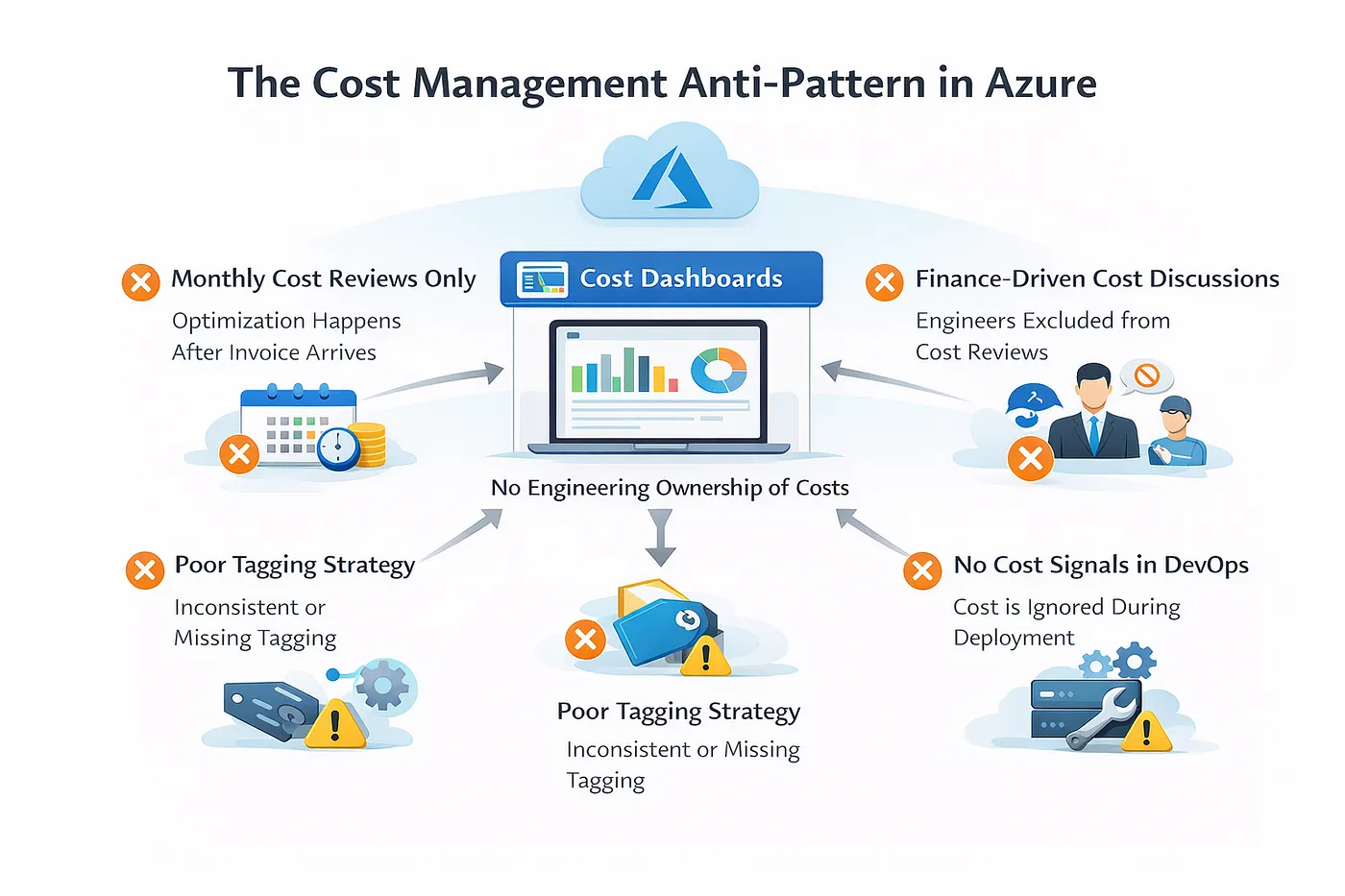
Cost visibility without ownership
Dashboards exist, but no engineering team is accountable for the cost of the services they operate.
Reactive cost analysis
Cost investigations only occur after invoices are generated.
Finance-centric FinOps conversations
Cost discussions happen outside engineering workflows, limiting their operational impact.
Inconsistent tagging strategies
Resources lack standardized tagging, making cost attribution unreliable.
These patterns create a gap between cost visibility and cost accountability. To close this gap, organizations must integrate cost insights directly into their operational workflows.
What Operational FinOps Looks Like
Operational FinOps shifts the focus from retrospective analysis to continuous cost awareness.
Instead of reviewing costs once a month, cost insights become part of daily operational decision-making.
Key characteristics of operational FinOps include:
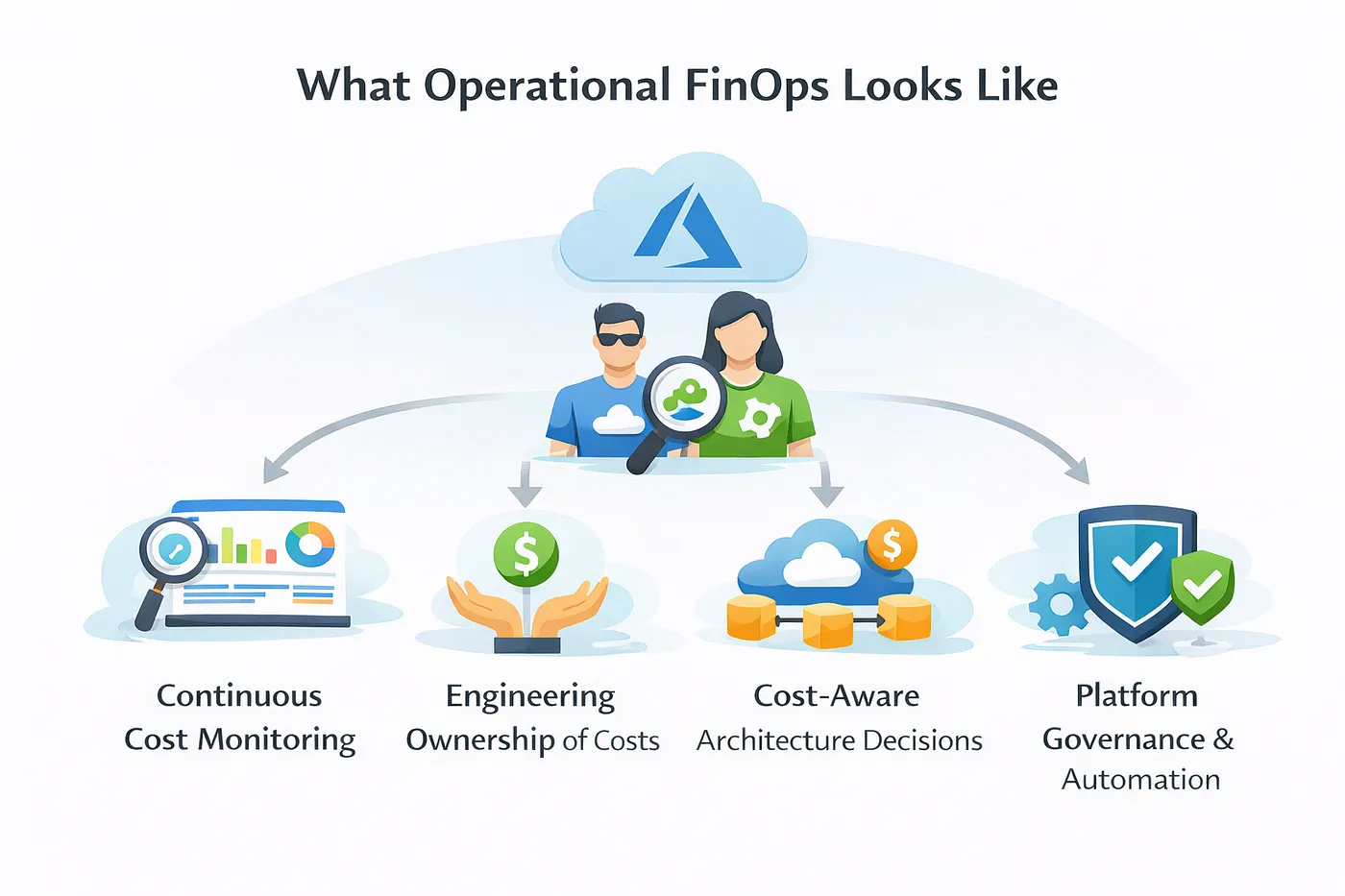
- Continuous monitoring of cloud spending
- Engineering ownership of resource costs
- Cost-aware architecture decisions
- Platform-level governance and automation
- Cost insights integrated into engineering workflows
In this model, cost becomes another operational metric — alongside reliability, security, and performance.
The Azure FinOps Toolkit was created to support exactly this transition.
What Is the Azure FinOps Toolkit?
The Azure FinOps Toolkit is an open-source collection of tools developed by Microsoft to help organizations implement FinOps practices in Microsoft Cloud environments.
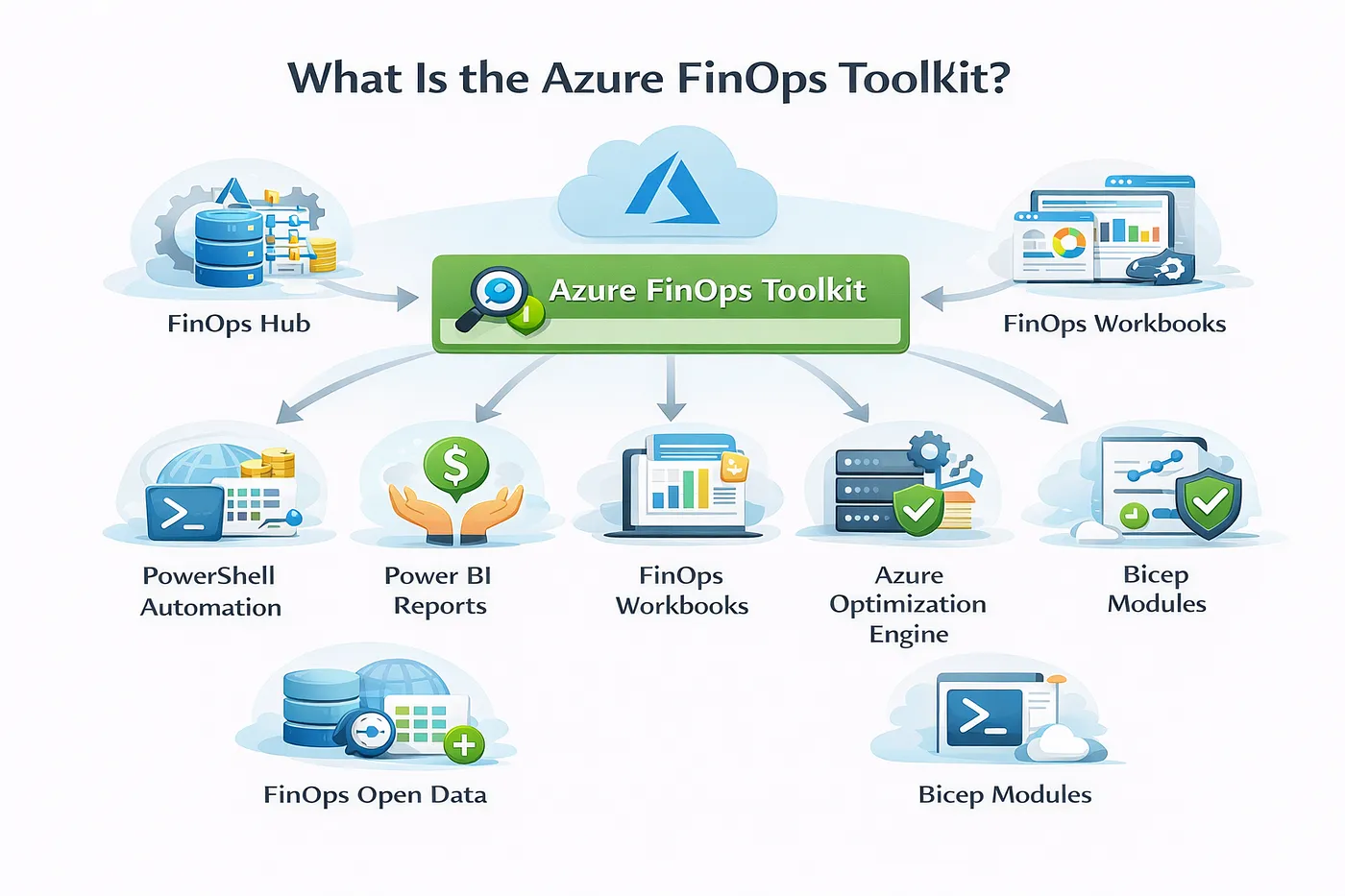
Rather than replacing Azure Cost Management, the toolkit extends it by providing:
- centralized cost data ingestion
- advanced reporting and analytics
- operational dashboards
- automation capabilities
- infrastructure-as-code deployment models
These tools help organizations establish a scalable foundation for cost visibility, analysis, and optimization.
The toolkit consists of several core components:
- FinOps Hubs
- Power BI Reports
- FinOps Workbooks
- Azure Optimization Engine
- PowerShell Automation
- Bicep Infrastructure Modules
- FinOps Open Data
Each of these components plays a specific role in operationalizing cloud cost management.
FinOps Hubs: Centralizing Cost Data
At the center of the toolkit is FinOps Hubs, which acts as the data backbone for cost analysis.
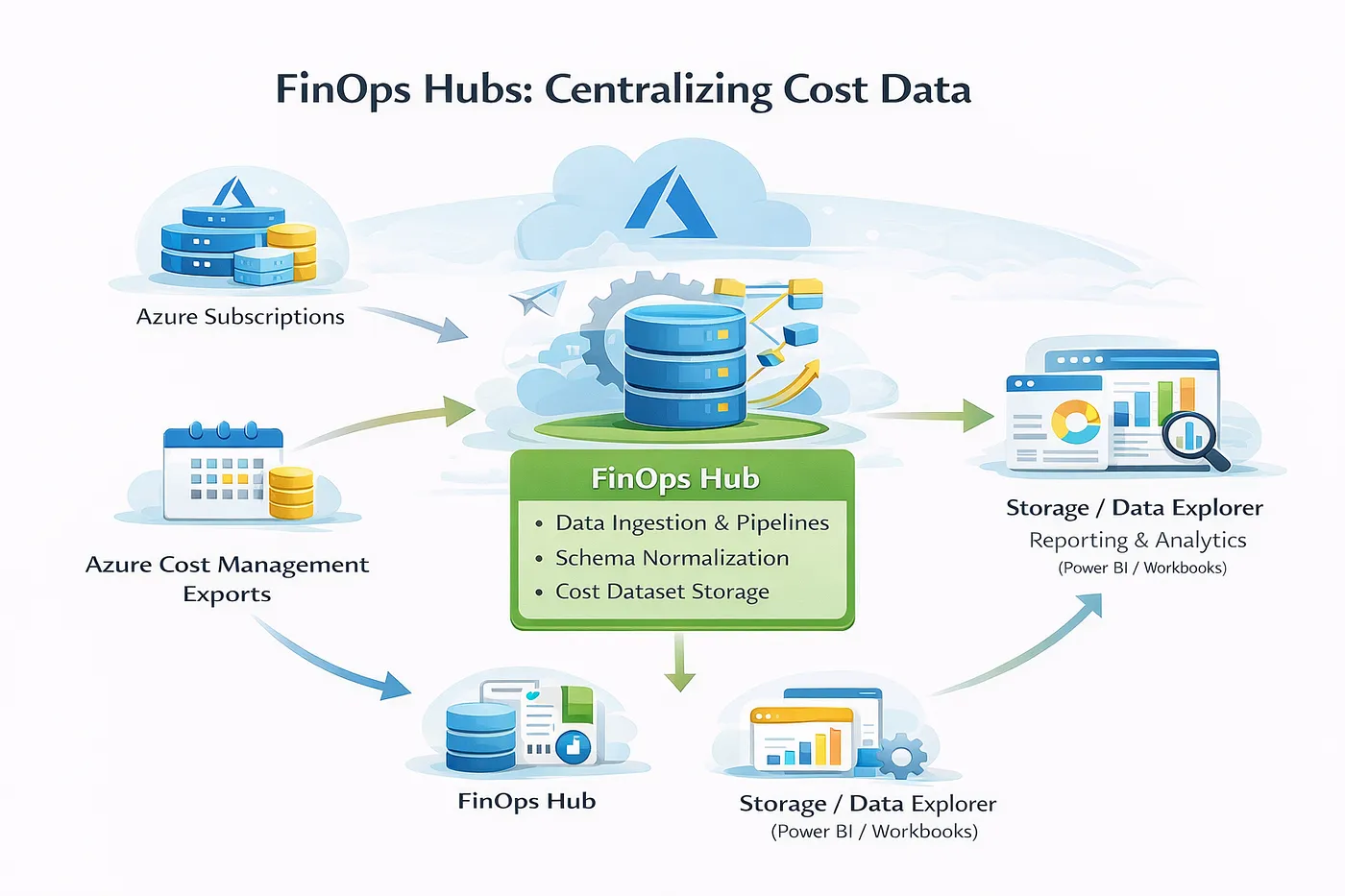
Large organizations often operate hundreds of Azure subscriptions, producing massive volumes of cost data. Querying cost data directly from Azure Cost Management can become inefficient at scale.
FinOps Hubs solve this challenge by creating a centralized cost data pipeline.
The hub architecture typically performs the following functions:
- ingesting cost exports from Azure Cost Management
- normalizing cost data into standardized schemas
- storing cost datasets for analytics
- enabling large-scale reporting and analysis
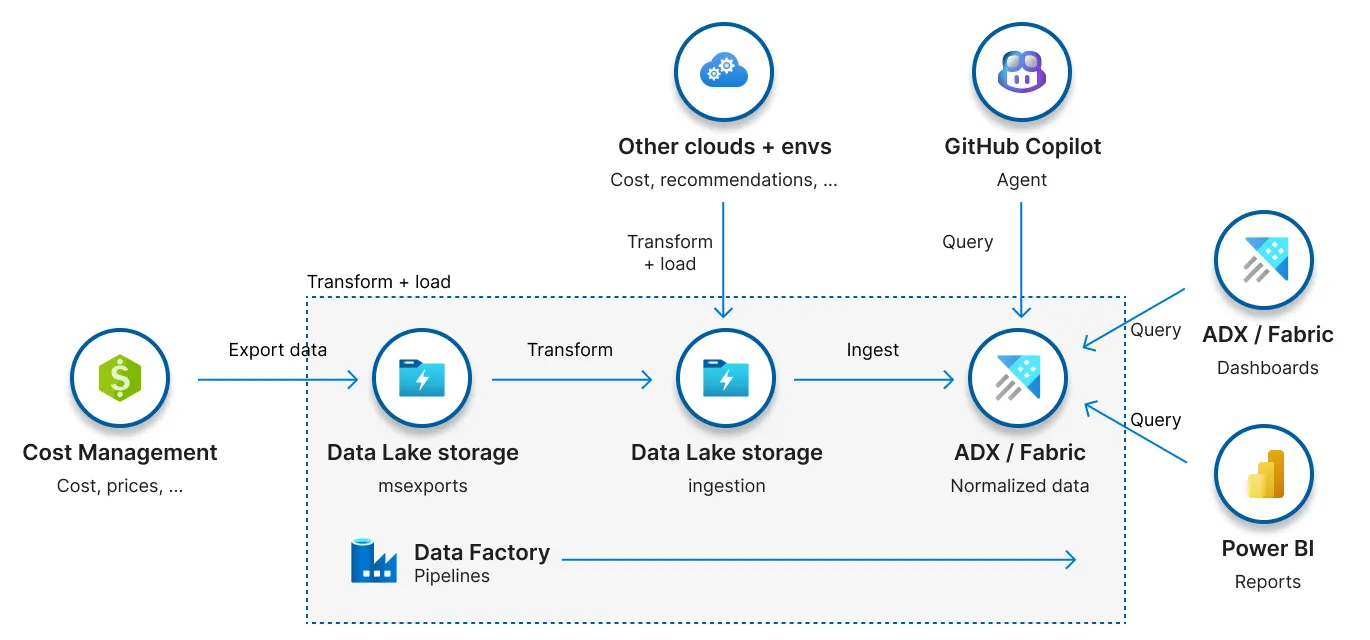
By centralizing cost data ingestion and transformation, FinOps Hubs enable organizations to build scalable analytics environments that support enterprise-level cost management.
This architecture allows reporting tools such as Power BI to query cost data efficiently while maintaining consistent cost data models across the organization.
Power BI FinOps Reports: Accelerating Cost Insights
The toolkit includes a set of pre-built Power BI reports designed for common FinOps scenarios.
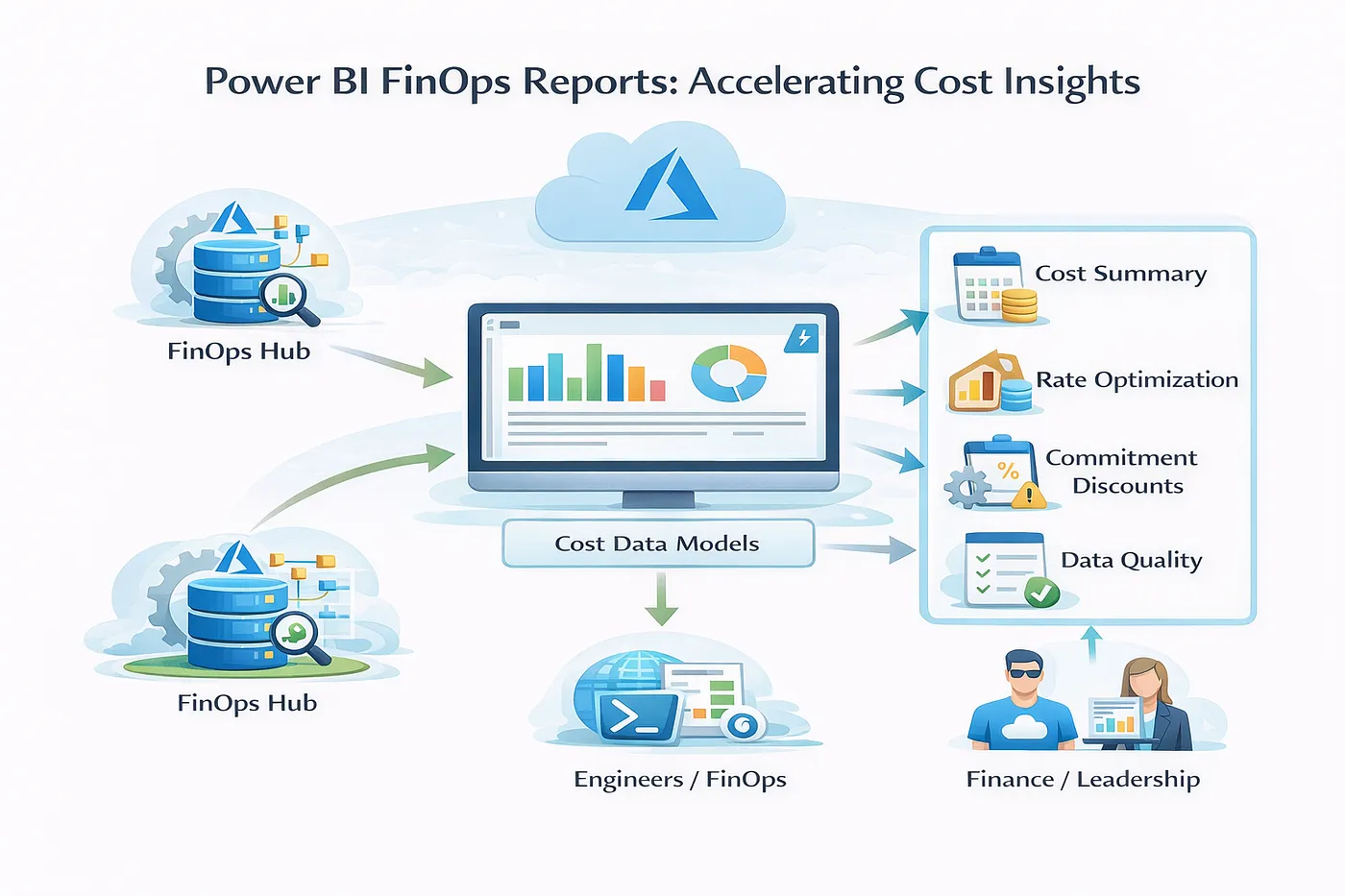
Instead of building dashboards from scratch, organizations can deploy these reports and immediately start analyzing cost trends.
The reports help teams answer important questions such as:
- Which Azure services drive the majority of spending?
- Which subscriptions show unusual cost growth?
- Are commitment discounts such as reservations or savings plans underutilized?
- Which resources show potential for optimization?
These reports typically include views such as:
- cost summary dashboards
- rate optimization insights
- commitment discount analysis
- data ingestion monitoring
Power BI enables both engineering and finance stakeholders to explore cost data interactively, improving transparency and enabling better decision-making across teams.
FinOps Workbooks: Operational Cost Dashboards
While Power BI focuses on analytical reporting, FinOps Workbooks provide operational dashboards directly within the Azure portal.
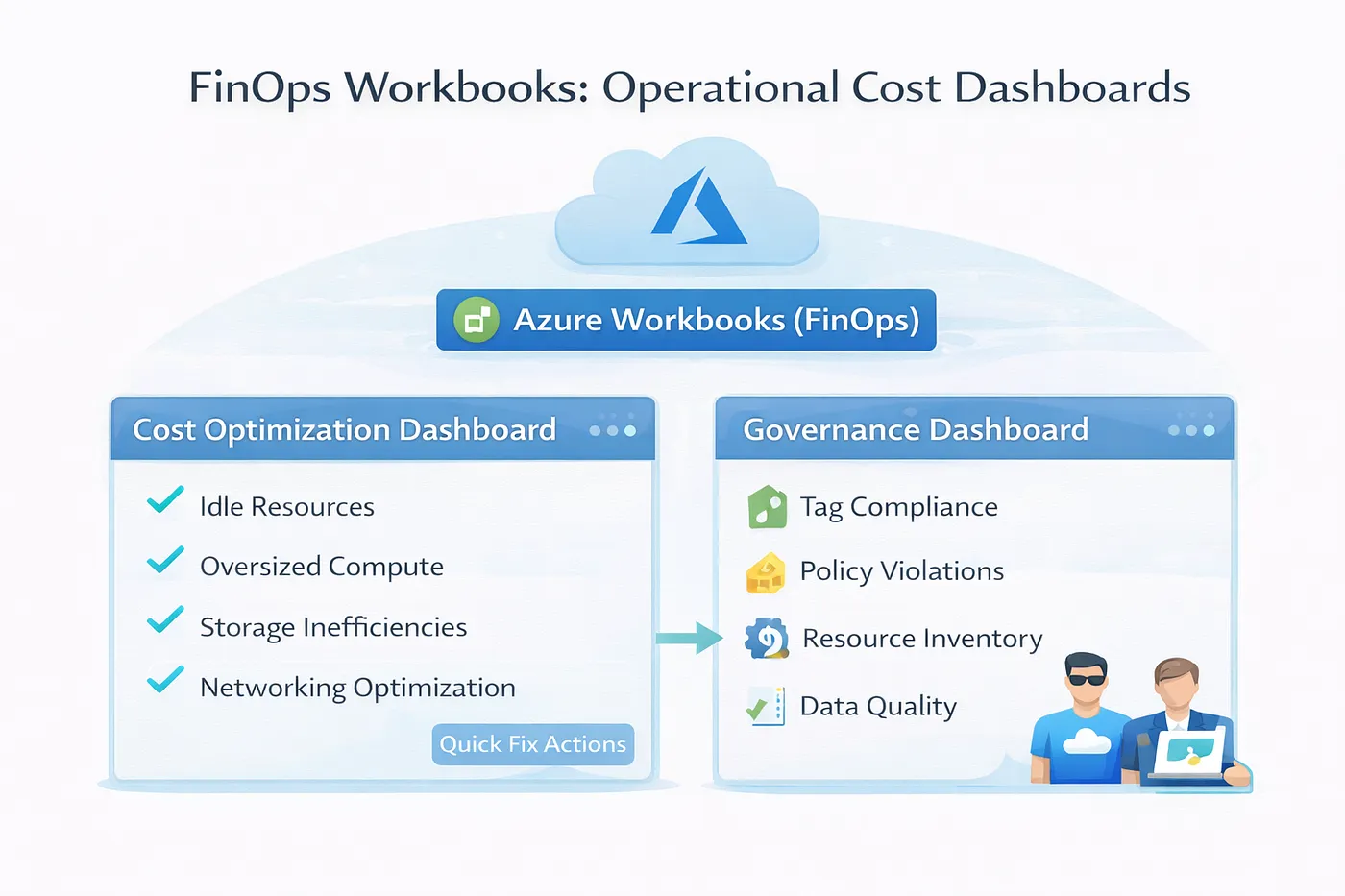
These interactive dashboards allow engineers and platform teams to explore cost optimization opportunities without leaving their operational environment.
Two key workbooks included in the toolkit are:
Cost Optimization Workbook
This workbook identifies potential optimization opportunities such as:
- idle virtual machines
- oversized compute resources
- underutilized storage
- networking inefficiencies
Governance Workbook
This dashboard focuses on governance and policy compliance by analyzing:
- tagging coverage
- policy compliance
- resource inventory
Because these dashboards are integrated into the Azure portal, they reduce friction between cost visibility and engineering action.
Engineers can identify optimization opportunities and immediately investigate affected resources.
Azure Optimization Engine: Generating Actionable Recommendations
The Azure Optimization Engine extends Azure’s native recommendations by aggregating data from multiple sources.
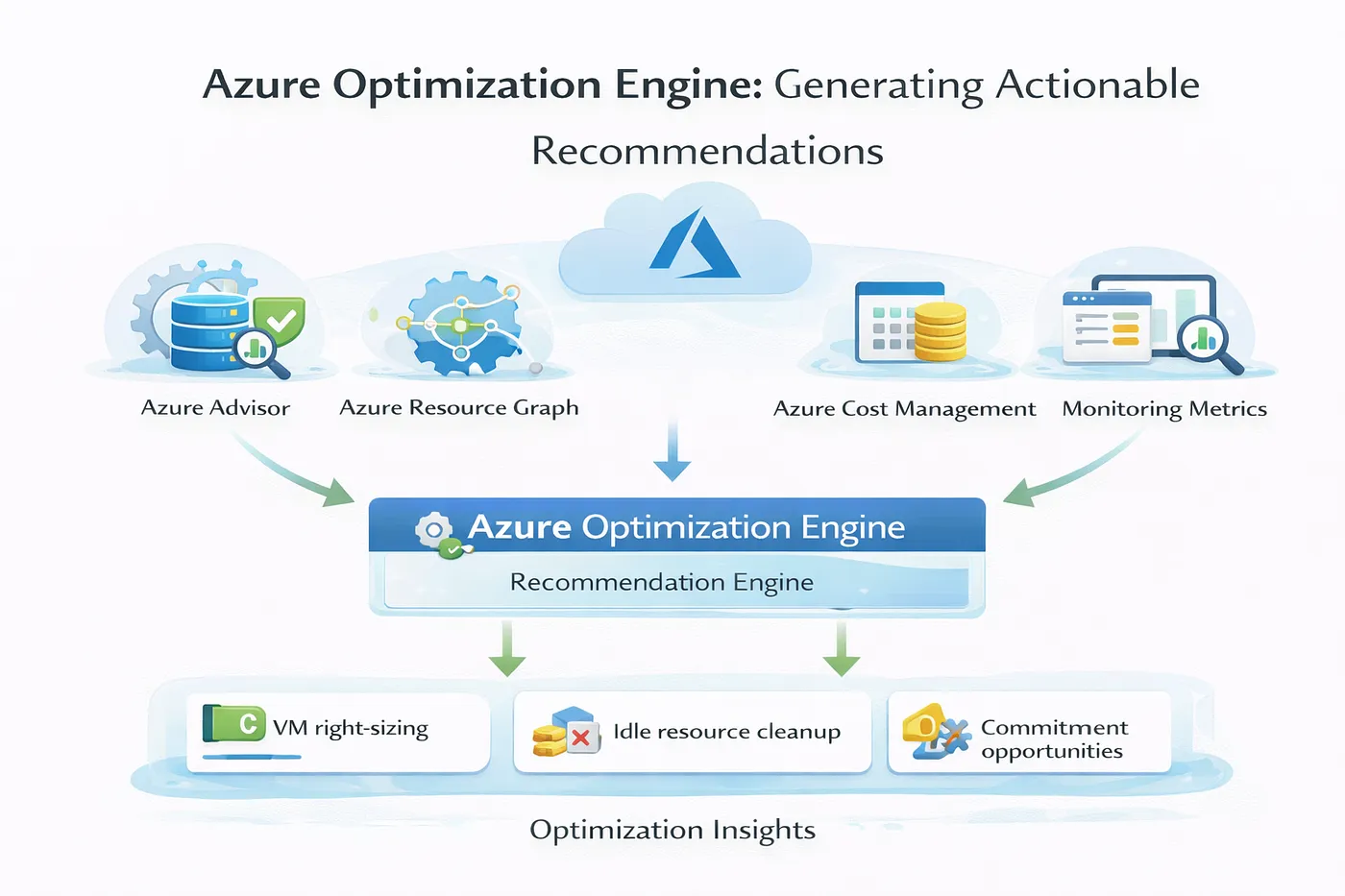
The engine collects signals from:
- Azure Advisor
- Azure Resource Graph
- Azure Cost Management
- Operational telemetry
Using this data, the engine generates structured optimization insights such as:
- right-sizing virtual machines
- identifying unattached disks
- detecting idle resources
- highlighting commitment discount opportunities
Rather than relying on isolated recommendations across different Azure services, the Optimization Engine provides a centralized recommendation framework.
This allows organizations to build customized optimization strategies tailored to their architecture and operational priorities.
PowerShell Automation: Scaling FinOps Operations
Manual cost management processes do not scale in complex cloud environments. The FinOps Toolkit therefore includes a PowerShell module designed to automate FinOps operations.
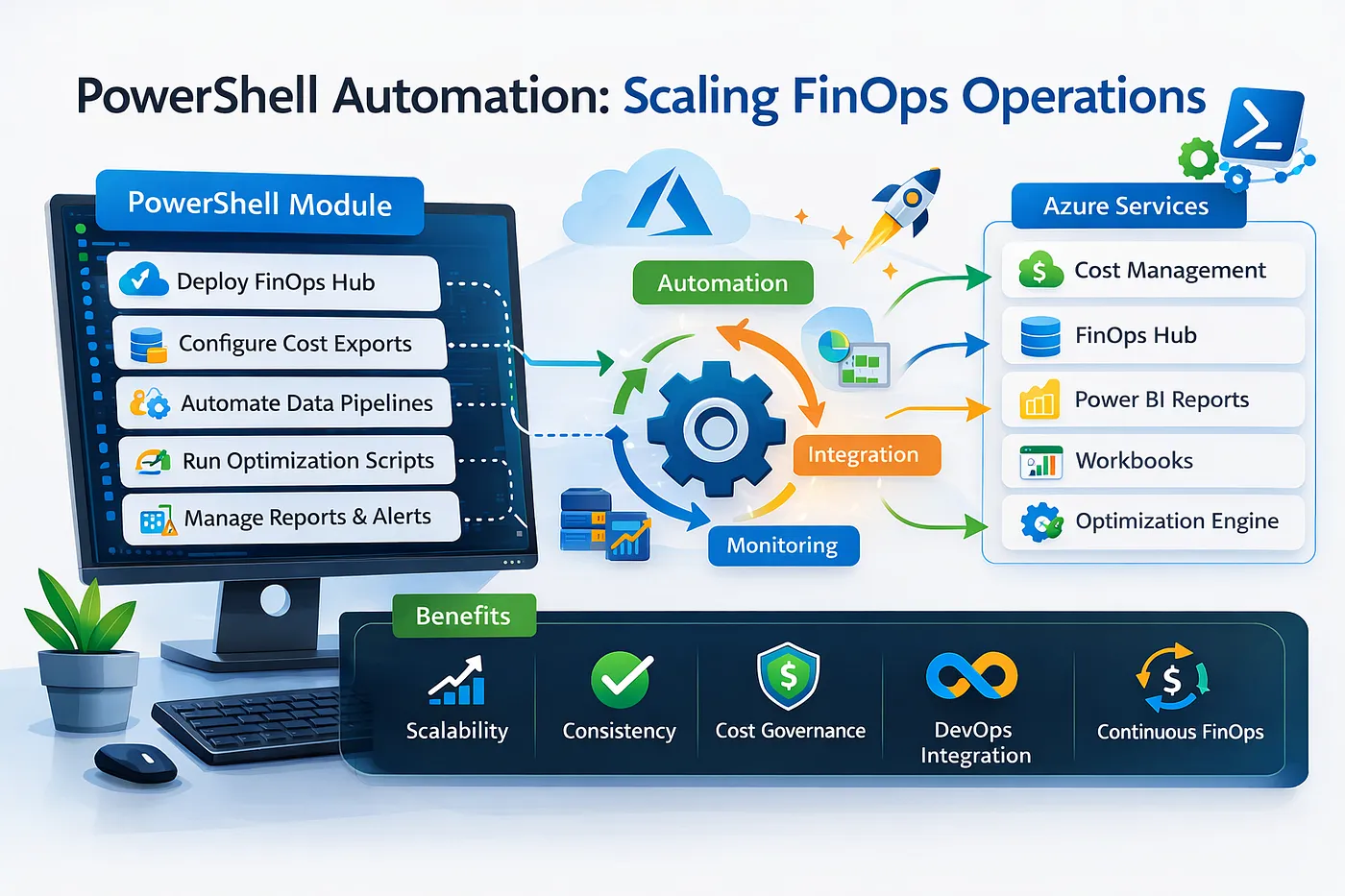
Common automation tasks include:
- configuring cost exports
- deploying FinOps hubs
- automating cost data ingestion pipelines
- running optimization workflows
These scripts enable organizations to integrate FinOps into DevOps pipelines and platform automation frameworks.
By automating FinOps infrastructure, organizations can maintain consistent cost governance across environments without requiring manual intervention.
Bicep Modules: FinOps Infrastructure as Code
The toolkit also provides Bicep modules that allow organizations to deploy FinOps infrastructure using Infrastructure-as-Code principles.
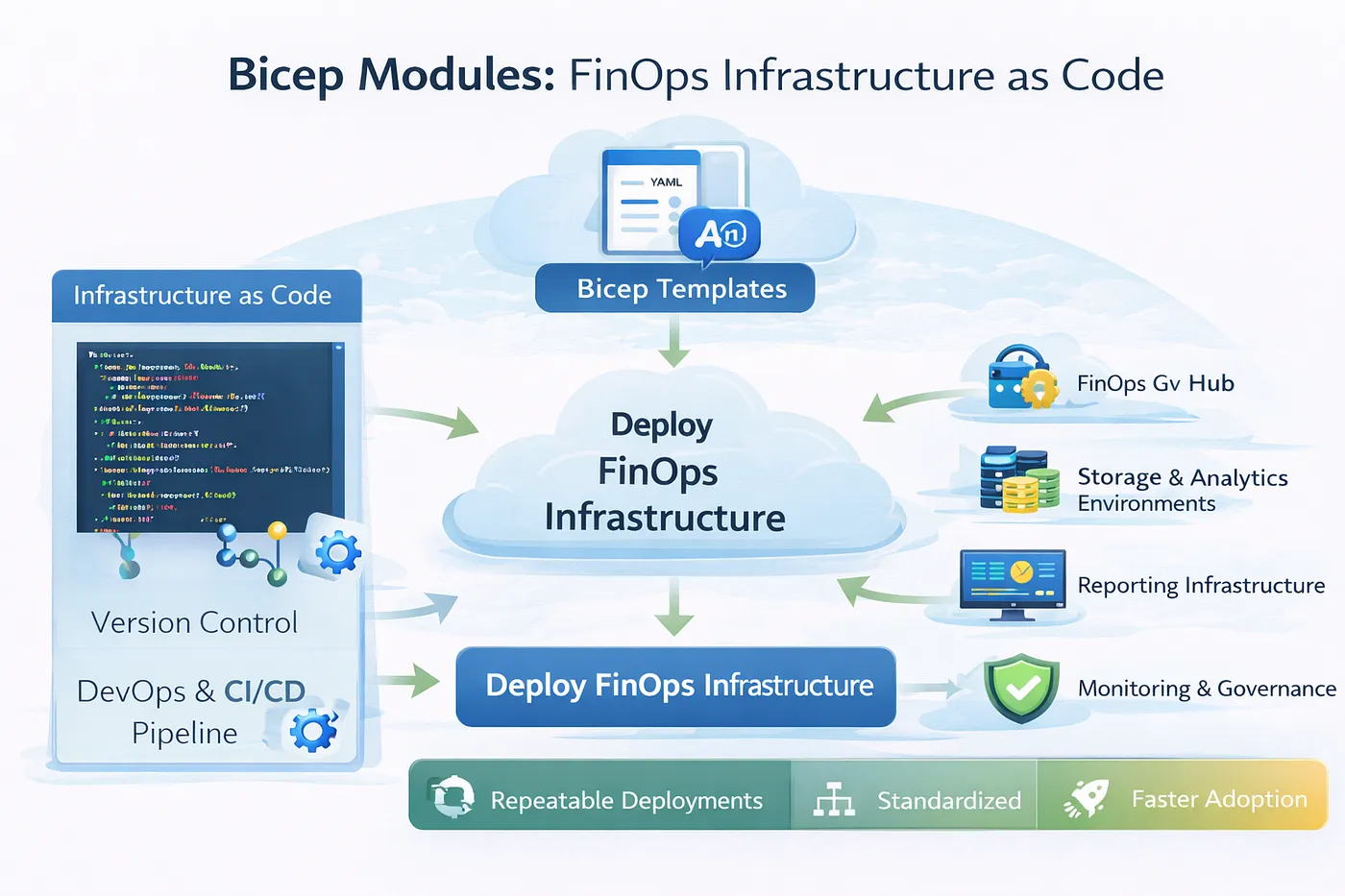
These modules can be used to deploy:
- FinOps hubs
- storage and analytics environments
- reporting infrastructure
- monitoring and governance configurations
Treating FinOps infrastructure as code ensures:
- repeatable deployments
- standardized architecture
- faster adoption across environments
For platform engineering teams already using Infrastructure-as-Code, this approach aligns naturally with existing deployment workflows.
FinOps Open Data: Standardizing Cost Analysis
Another valuable component of the toolkit is FinOps Open Data.
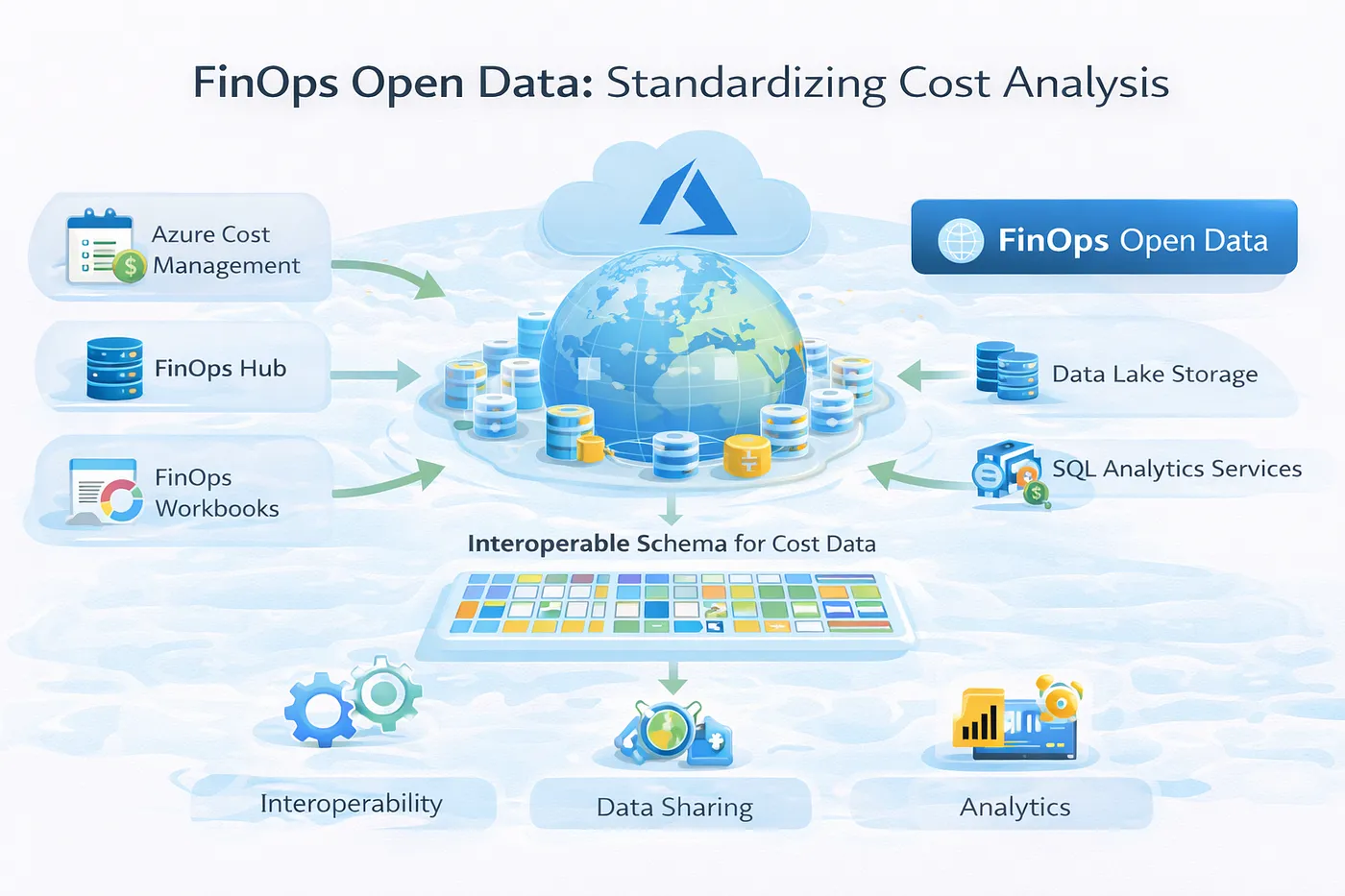
Cloud cost data can be difficult to interpret due to inconsistencies across services, pricing units, and resource metadata.
Open datasets included in the toolkit help standardize cost analysis by providing:
- Azure region metadata
- resource type mappings
- pricing unit definitions
- normalization datasets
These datasets improve the accuracy and consistency of cost analytics, particularly in large environments with complex service portfolios.
Lessons Learned from Implementing FinOps
Organizations adopting FinOps practices often discover that the biggest challenges are not technical but cultural.
Several lessons commonly emerge during FinOps adoption.
Tooling alone does not change behavior
Dashboards and reports provide information, but accountability drives action.
Engineering ownership is essential
When teams understand the cost of their services, optimization becomes part of normal operational practice.
FinOps requires cross-functional collaboration
Finance, platform teams, and engineering must work together to manage cloud spending effectively.
Consistency matters more than perfection
Even simple cost attribution models can significantly improve cost awareness when applied consistently.
The Azure FinOps Toolkit helps organizations structure this transition by providing practical tools for integrating cost insights into operational workflows.
Moving from Reactive Reporting to Operational FinOps
Sustainable Azure cost management requires more than dashboards and monthly reviews.
Organizations that successfully manage cloud spending treat cost as an operational concern rather than a financial afterthought.
By embedding cost insights into engineering workflows and establishing clear ownership of cloud spending, teams can move toward a more proactive and sustainable FinOps model.
The Azure FinOps Toolkit provides a practical foundation for this journey, helping organizations bridge the gap between cost visibility and operational accountability.
As cloud environments continue to grow in complexity, operationalizing FinOps will become an essential capability for organizations operating at scale in Azure.
If you’re interested in implementing the Azure FinOps Toolkit in your own environment, the official documentation and open-source repository are excellent starting points.
References
Azure FinOps Toolkit
- Microsoft Learn — Azure FinOps Toolkit Overview
https://learn.microsoft.com/en-us/cloud-computing/finops/toolkit/finops-toolkit-overview - Azure FinOps Toolkit GitHub Repository
https://github.com/microsoft/finops-toolkit
FinOps Hubs
- FinOps Hubs Overview
https://learn.microsoft.com/en-us/cloud-computing/finops/toolkit/finops-hubs-overview - Deploying FinOps Hubs
https://learn.microsoft.com/en-us/cloud-computing/finops/toolkit/finops-hubs-deploy
Power BI FinOps Reports
- FinOps Toolkit Power BI Reports
https://learn.microsoft.com/en-us/cloud-computing/finops/toolkit/power-bi - Power BI Documentation
https://learn.microsoft.com/en-us/power-bi/
FinOps Workbooks
- FinOps Toolkit Workbooks
https://learn.microsoft.com/en-us/cloud-computing/finops/toolkit/workbooks - Azure Monitor Workbooks Documentation
https://learn.microsoft.com/en-us/azure/azure-monitor/visualize/workbooks-overview
Azure Optimization Engine
- Azure Optimization Engine (GitHub)
https://github.com/microsoft/azure-optimization-engine - Azure Advisor Documentation
https://learn.microsoft.com/en-us/azure/advisor/advisor-overview
FinOps Open Data
- FinOps Open Cost and Usage Specification (FOCUS)
https://focus.finops.org/ - FinOps Foundation
https://www.finops.org/
Infrastructure as Code (Bicep)
- Azure Bicep Documentation
https://learn.microsoft.com/en-us/azure/azure-resource-manager/bicep/overview
Azure Cost Management
- Azure Cost Management Documentation
https://learn.microsoft.com/en-us/azure/cost-management-billing/cost-management-billing-overview
FinOps Framework
- FinOps Framework Overview
https://www.finops.org/framework/